Party Wall Agreements in London: A Homeowner’s Guide for Extensions and Loft Conversions
By the Golbik GBS team · Blog
If you live in a London terrace or semi-detached house, almost any loft conversion or extension will affect a wall you share with your neighbour. The Party Wall etc. Act 1996 sets out how that work must be notified and agreed. Getting it right early keeps the project on time and the neighbours on side.
Key takeaways
- The Party Wall etc. Act 1996 applies to most loft conversions and many extensions on terraced and semi-detached houses.
- There are three main notices: party structure (two months), line of junction (one month) and adjacent excavation (one month).
- A neighbour has 14 days to respond; silence counts as a dispute, which is resolved by party wall surveyors.
- Party wall consent is separate from planning permission and Building Regulations.
- Serving notices early and talking to neighbours first is the simplest way to avoid delays.
What Is the Party Wall Act?
The Act gives homeowners the right to carry out certain work to or near a shared wall, and gives neighbours protection while that work is done. It applies in England and Wales to party walls between houses, party structures such as floors between flats, boundary walls and excavation close to a neighbour’s foundations.
The Three Party Wall Notices
| Notice | When it applies | Minimum notice |
|---|---|---|
| Party structure notice | Work to an existing party wall: cutting in steel beams, raising the wall, removing chimney breasts, inserting a damp-proof course | 2 months |
| Line of junction notice | Building a new wall on or astride the boundary, for example for a side-return or rear extension | 1 month |
| Adjacent excavation notice | Digging foundations within 3 metres of a neighbour’s building and deeper than their foundations (or within 6 metres in some cases) | 1 month |
Notices must be served on every adjoining owner, which can include a freeholder and long leaseholders of flats next door, not just the person living there.
How the Process Works, Step by Step
- Talk to your neighbours first. Explain the plans and timetable before anything arrives in writing.
- Serve the notices. Include a description of the work, drawings where relevant and the proposed start date.
- Wait for a response. The neighbour has 14 days to consent or dissent.
- Consent: work can go ahead after the notice period. A schedule of condition of the neighbour’s property is still strongly recommended.
- Dissent or no reply: surveyors are appointed, either one agreed surveyor or one each, and they prepare a Party Wall award.
- Work starts in line with the award, and the surveyors deal with any damage claims afterwards.
Which Projects Need a Party Wall Notice?
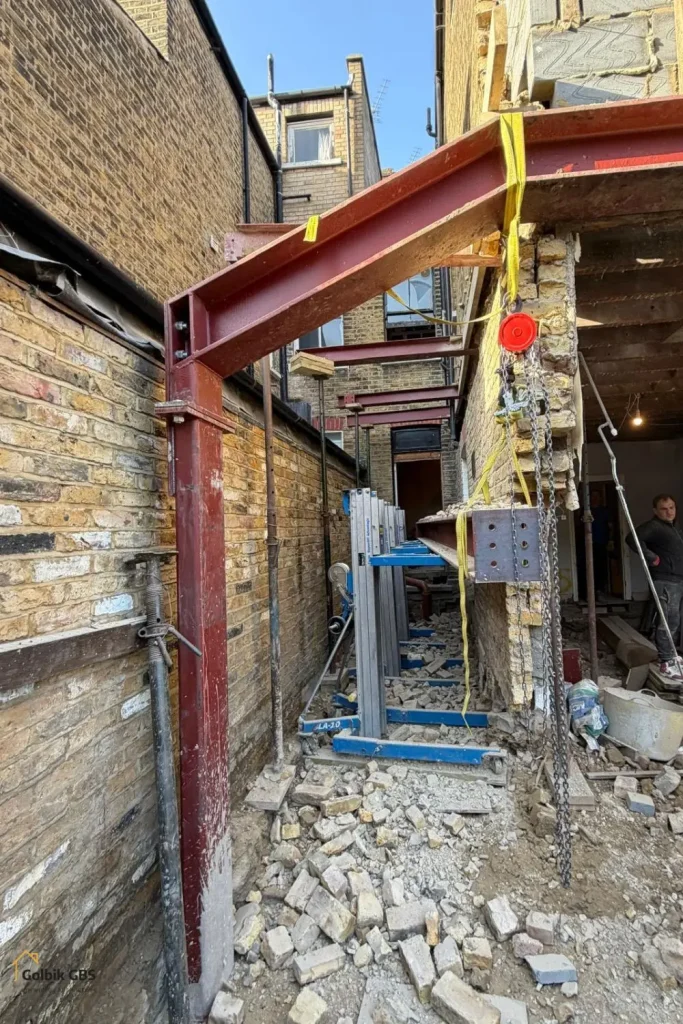
- Loft conversions – steel beams bearing on the party wall and any raising of the wall. See our guide to loft conversion types.
- Side-return and rear extensions – new walls on the boundary and foundations close to the neighbour. See extension types compared.
- Removing chimney breasts – the chimney stack is usually part of the party structure.
- Underpinning and new foundations near a shared wall.
Minor work such as fixing shelves, re-plastering or rewiring sockets in a party wall does not normally need a notice.
Timing Your Project
Because a party structure notice needs two months, and a dispute adds time for surveyors and the award, it is sensible to serve notices as soon as the design is fixed, in parallel with planning or permitted development checks. Our guide to planning rules by London borough explains that side of the process.
Most of the houses we work on are terraces and semis. Our area guides cover Clapham, Fulham, Chelsea, Hammersmith, Dulwich and Mitcham.
Frequently Asked Questions
Do I need a Party Wall agreement for a loft conversion?
Usually, yes. Most loft conversions on terraced and semi-detached houses involve cutting into the party wall to support new steel beams or raising the wall, which requires a party structure notice at least two months before the work starts.
What happens if my neighbour does not reply to the notice?
If the adjoining owner does not respond within 14 days, a dispute is deemed to have arisen. Each side can appoint a surveyor, or both can agree on one, and the surveyors produce a Party Wall award that sets out how the work will be done.
Who pays for the party wall surveyor?
As a rule, the building owner carrying out the work pays the reasonable costs of the surveyors, including the surveyor appointed by the neighbour.
How long is a Party Wall notice valid?
A notice lapses if the work does not start within 12 months of it being served, so it should be timed with the planned start date.
Is a Party Wall award the same as planning permission?
No. The Party Wall Act deals with the relationship between neighbours. Planning permission or permitted development and Building Regulations approval are separate requirements.
Planning an Extension or Loft Conversion?
Golbik GBS builds loft conversions and house extensions across London and helps clients plan the Party Wall process into the programme from the start. Get in touch to arrange a survey.
Related Guides
- Full House Refurbishment in London: Stages, Permissions and Timeline
- Loft Conversion Types for London Homes
- Side-Return, Rear or Wraparound Extension?
- Planning a Kitchen Renovation in a London Home
- Bathroom Renovation in London: Wet Rooms, Waterproofing and Safety Zones
- Does Your London Home Need Rewiring?
- Upgrading Heating and Plumbing in an Older London Home
- Do You Need Planning Permission? Rules by London Borough
- Extending a 1930s Semi in Sutton, Wallington and Mitcham
- Consumer Unit (Fuse Box) Upgrades Explained
- Renovating a Victorian Terrace in South West London
- How to Choose a Builder in London